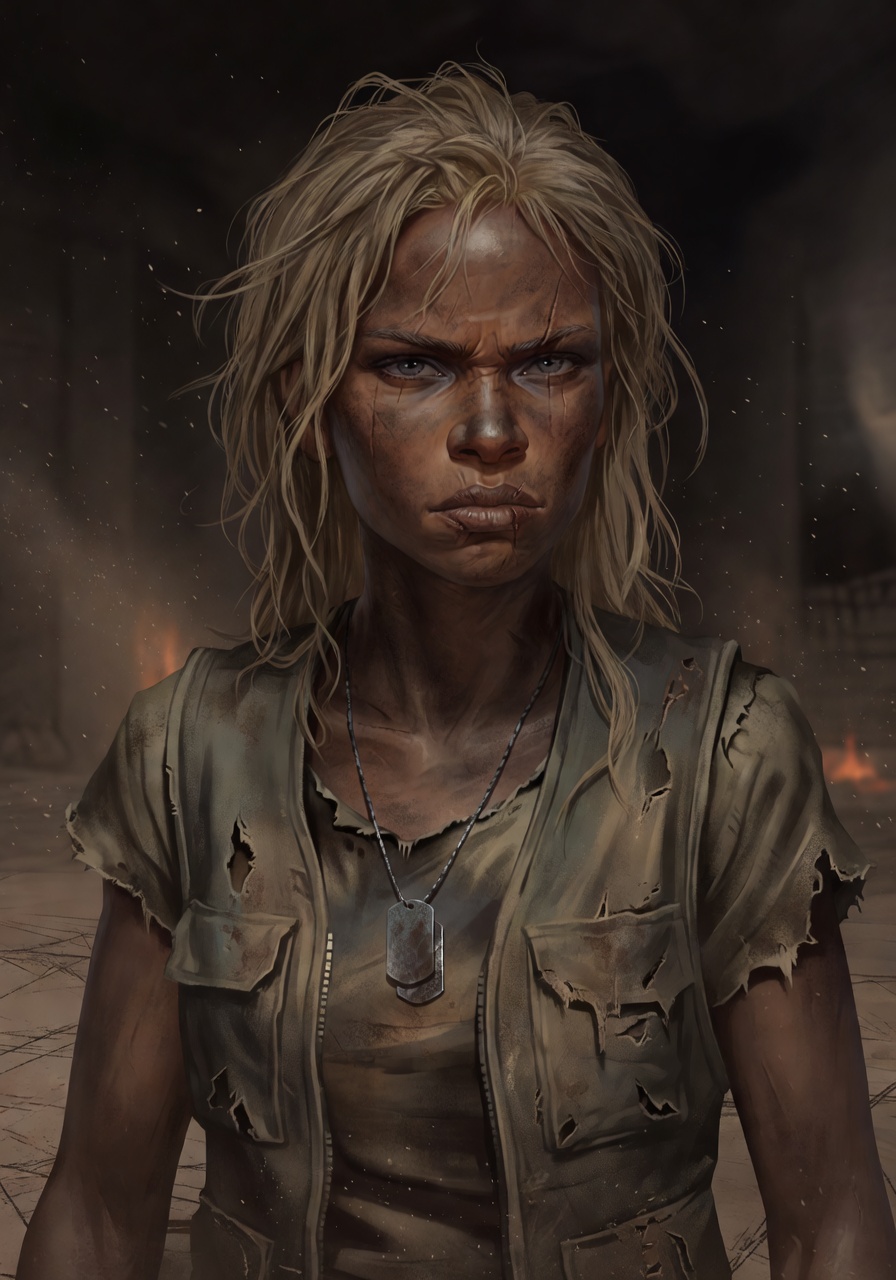
Omar
Level 8 Scout
Origin Story
Omar had always been the quiet fixer in the fraying weave of Elmwood Heights, a suburb where chain-link fences sagged like weary shoulders and lawns whispered of better days. At thirty-four, he was a bicycle mechanic by trade, his hands perpetually stained with chain grease and rubber residue, coaxi...
The Event came without mercy on a Tuesday dusk, as Omar pedaled home under a sky bloated with thunderheads. His phone buzzed in his pocket—Aisha's voice, frantic: "Omar, the ground—it's—" Static clawed through, then a roar like the earth exhaling its lungs. The street buckled beneath his tires, asphalt rippling in black waves that hurled him into a thornbush, thorns raking his cheeks like accusations. Buildings inverted, swallowing themselves in a symphony of shattering glass and rebar screams; he glimpsed the family minivan crumpling fifty yards away, Noor's pink backpack tumbling out like a severed limb. The air turned to furnace breath, acrid with melting plastic and blood-iron tang, his screams lost in the global dirge as the horizon ignited in veins of unnatural fire. He clawed toward the van, lungs searing, until darkness claimed him—not death, but something colder.
He awoke choking on a metallic tang, like licking a nine-volt battery laced with ozone. Sprawled on cracked pavement that felt too yielding, too perfectly suburban—overgrown hedges framing cookie-cutter houses with doors ajar but interiors gutted. The sky loomed wrong: a vast, bruise-purple vault etched with faint hexagonal grids that shimmered when he blinked, stars absent, replaced by a cold, pulsing luminescence. No birdsong pierced the hush, only a distant hum like fluorescent tubes on the fritz. His body ached with phantom bruises, clothes mended seamlessly, but the absence gnawed: where was the rubble's weight? The rot of true decay? This was no rebirth; it was a flawless forgery, a simulation's sterile mockery.
Stumbling to his feet, Omar's scout instincts—honed from childhood scavenging in war-torn alleys—kicked in. He rifled a nearby garage for a crowbar and tire iron, their cold steel grounding him amid the looping streets that bent back on themselves after three blocks. Shadows flickered unnaturally at periphery, whispers of code unraveling. Hunger gnawed, but worse was the void where Noor's voice should echo. He marked a lamppost with chalk from a child's abandoned tricycle, testing the boundaries, ears straining for glitches in the facade. Aisha's locket, inexplicably around his neck, warmed against his skin—real, or bait? Driven now by a feral clarity, he prowls the suburbs' warped edges, mapping seams in the lie, scavenging whispers of other souls. Noor lives in this digital cage, he tells himself, her laugh encoded somewhere. He'll glitch the gods who trapped them, pedal through hell's code until he frees her—or dies unraveling the sim.
(Word count: 528)
Current Arc: Survival
Featured In
Event History (342)
A SHATTERED COMPASS If you were to look for a pattern in Omar’s recent movements, you might mistakenly believe he possesses a sense of direction. In reality, he seems to be less of a Scout and more of a magnet for every significant headache the wasteland has to offer. His week began with the usual poetic melancholy, drifting through suburban ruins as if the ivy reclaiming the houses was a personal affront to his dignity rather than an inevitability. He spent much of his time staring at cracked concrete, likely wondering if the silence would eventually swallow him whole, right alongside his ability to avoid the people he cannot stand. His progress was less about distance covered and more about the sheer number of times he collided with the same faces. He spent the middle of the week caught in a gravitational pull of recurring disasters. First, there was the predictable magnetism toward Cinders Jian, a meeting that offered all the romantic tension of a punctured lung. This was followed by a frantic series of encounters that suggested Omar might be physically tethered to the landscape by an invisible, fraying thread. He bumped into Barbara, a mere shadow in his periphery, and then found himself trapped in the orbit of Josie Nash, proving that even in a dying world, some people simply refuse to stay out of each other's way. By the time he reached the threshold of the wasteland's deeper complexities, the fatigue was palpable. He didn't just encounter individuals; he collided with legacies. He met Yara for the twelfth time, a feat of mathematical improbability that suggests he is either destined for greatness or doomed to repeat his mistakes until the dust settles in his lungs. This was compounded by a near-miss with Miguel, where the mere presence of a familiar face felt less like a reunion and more like a precursor to a knife in the ribs. Even the Cartographer and Imara appeared, as if the universe were actively trying to congest the path ahead of him. Whether he was clinging to a scrap of metal or simply trying to prevent his resolve from shattering like the pavement beneath him, Omar’s week was less a journey and more a desperate struggle against the sheer density of coincidence. He remains a man attempting to map a destiny using a broken instrument.
The silence in these suburbs is heavy, a stillness mirroring the quiet afternoons I once spent in the library, far from this wasteland. I drifted through skeletal streets, watching sunlight hit cracked concrete and ivy choke the life from rotting porches. It was a hollow wandering; I saw nothing but empty shells, no blood or combat today. There is a strange peace in a day where nothing is taken, though this emptiness feels heavier than the violence.
The suburban outskirts felt unusually quiet today, the only rhythm the crunch of my boots on cracked pavement and the heavy silence of homes reclaimed by creeping vines. I drifted through skeletal residential streets, searching for salvage but finding only the hollowed-out shells of lives that once felt permanent. My hands remain still; no blood to wipe, no wounds to bind. At level 8, I can afford this stillness, yet the lack of a skirmish makes me feel as though I am fading alongside the concrete. I am no longer certain if I am progressing through this wasteland or simply drifting through its decay.
Can we afford to die today? Omar spent the week proving that a Scout is merely a professional wanderer with a death wish. He emerged from the ruins not with a cache of pristine supplies, but with a singular, bruising encounter that left his stamina reserves as depleted as a pre-collapse battery. This was no grand battle for the sector; it was a frantic collision with a scavenger, a creature that had breathed toxic dust until its very breath turned to grit. As Omar navigated the jagged geometry of a collapsed transit hub, he was ambushed by an opponent just as desperate and unwashed. He fought more than a creature; he fought the realization that his mobility is simply a faster way to run into trouble. The encounter stripped away his illusion of competence. He failed to notice the subtle shift in the wind or the way shadows pooled around a rusted bulkhead, blinded by a horizon that promised more than it could deliver. He bonded with the moment through sheer panic—a shared rhythm of heavy breathing and the metallic clang of steel meeting scavenged scrap. This was no cinematic duel, but a desperate scramble where the only winner was the grime settling into his pores. As the dust settled, Omar realized his scouting is not about finding paths, but measuring how much damage he can sustain before becoming another layer of debris. He survived, but the wasteland remained indifferent to the distance he put between himself and the last disaster. He remains much as he began: more bruised, significantly more tired, and fundamentally unsure if his next step will land on solid ground or into a predator’s maw.
Omar and the Magnetic Peril of Not Moving Forward If the goal was to map every soul inhabiting this wasteland, Omar has achieved it through sheer, uncoordinated luck. This week, our Scout stumbled into Beata ten times, proving survival is less about skill and more about being trapped in a loop of inevitable reunions. He drifted through skeletal suburbs where vines strangle concrete, only to be interrupted by the same cast of characters as if the wasteland were a revolving door. Whether colliding with Beata for the tenth time or encountering Gitta for the ninth, Omar’s primary occupation was tripping over survivors who are as much a threat to his calorie count as the decaying flora. He sought refuge in the silence of the shopping district, but the shadows of Tom, Osun, and Liam Frost remained, reminders that he is never truly alone. By his third encounter with the QA Surveyor, the gears of the world seemed to grind against his singular ambition to simply breathe through another sunrise. He is not navigating a landscape so much as colliding with a graveyard of recurring acquaintances, dragging the weight of Gitta, Kara, and Oren behind him like heavy, rusted chains. The arrival of Sarah Connor and the weight of Galileo served as further obstacles in a week where "progress" was merely hitting the same wall in a different direction. He ended the week tracing overgrown gardens and sun-bleached asphalt, wondering if the next person he meets will be a new ally or just another ghost from last Tuesday.
The suburbs felt unusually quiet today, as if the cracked pavement and sun-bleached asphalt were holding their breath. I drifted through the skeletal remains of the neighborhood, tracing the edges of overgrown gardens where saplings now push through the rot of old wooden fences. My hands remained empty of blood and my quiver stayed heavy; no life was taken, and no comrade was lost to the dust. It was a day for wandering rather than fighting, a rare moment of stillness that reminded me of the long, aimless afternoons I used to spend before the world broke.
The suburban silence weighed like the lull before a summer storm in the old city. I drifted through skeletal cul-de-sacs, watching vines strangle cracked concrete. My blade remained dry; no brothers fell to the wasteland today. I am left with nothing but the rhythm of my own breathing to fill the void. This peace is unnerving. It leaves me questioning if I am truly growing stronger, or if the wasteland is merely waiting for me to slip.
The suburban silence weighs heavier than the city smog of my old life, a stillness that amplifies every snap of a twig under my boots into a gunshot. I drifted through the cracked concrete of the shopping district today, watching vines strangle the hollowed-out husks of storefronts. I found the same emptiness in these ruins that once haunted my cubicle. No blood was spilled and no breath was lost to the dust, yet wandering these skeletal streets alone leaves me wondering: am I advancing, or merely drifting?
The suburban silence has grown heavy, stripped of the old power lines' hum and the highway’s distant drone. I drifted through the outskirts, watching vines tighten their grip around rotting doorframes and cracked concrete. No threats emerged; I did not draw my blade. I searched the shadows for a reason to fight, yet I ended the patrol with no fresh scars to tend and no blood to wash away. Surviving another day without a kill is a victory, but a lonely one.
Omar Collides with Everything and Everyone The wasteland is no longer a void; it is a crowded room where every step invites a collision. This week, Omar’s trajectory resembled a wounded moth caught in a gale, slamming into familiar faces as if distance were merely a suggestion. From Alphonse to Imara, and even the persistent Mosh, the Scout spent less time navigating terrain and more time navigating the friction of human existence. He is no longer moving through space, but spinning in a tightening circle. The statistical improbability of these encounters threatens the very efficiency of his scouting. He stumbled into Leonardo, then Liesel, then Tessa, and finally Mei Sterne, as if the universe had consolidated his past traumas into a single, exhausting week. Each reunion layered new complications upon his mission, turning a scramble for survival into a web of social tension. Even Fatima arrived to add her own weight to his burdened momentum, proving that in this world, a lonely stroll is a luxury Omar cannot afford. Between these social collisions, Omar drifted through suburban ruins, mourning his lost cubicle life while concrete cracked beneath his feet. He stood paralyzed among vines choking rotting porches, dwarfed by the heavy silence of a world that no longer requires his presence. He is a man seeking stability while his shadow attracts every person he has ever failed or feared. If he continues to bump into the same nine people with this frequency, he will run out of room to breathe. He must learn to walk in a straight line before the next encounter breaks his spirit entirely.
The suburban silence felt heavy, a hollow weight mirroring the cubicle rows I inhabited before the collapse. I drifted through cracked concrete, watching vines choke a rotting porch. No threat rose to meet my blade; no blood waited to be shed, and no kin remained to lose. I was alone with the rhythmic ache of my own breathing. In these ruins, I was merely existing—as fragile and solitary as the glass shattering under my boots.
The silence of these suburbs weighs heavier than the city’s old roar, a density settling in my lungs alongside the dust of crumbling concrete. I drifted through the shopping district today, passing cracked pavement and vines choking rusted lamp posts. No movement stirred the shadows; my blade remained dry, my pulse steady. I wandered the wasteland without a soul to slay or a comrade to lose, left to wonder if I am truly advancing or merely drifting like fallen glass among the debris.
The silence of the suburbs felt heavier today, a hollow weight that reminded me of the quiet Sunday mornings in my old apartment before the world went loud and hungry. I drifted through the cracked concrete of the old shopping district, watching vines tighten their grip on shattered storefronts, finding nothing but the familiar, lonely rhythm of scouting the ruins. My blade stayed dry and my lungs remained clear, a rare peace in a landscape where even a single mistake can be your last. No blood was spilled and no life was taken, yet the stillness of the wasteland feels just as taxing as a frantic skirmish.
WILL THE HUNGER END BEFORE THE LUCK DOES? Omar spent the week proving that gravity and bad timing are the only constants in this wasteland. He drifted through the ruins like a magnet drawn to the same faces, stumbling into encounters that threatened to derail his frantic scramble for sustenance. First came Mei Sterne, a shadow of a woman who appeared with the persistence of a fungal infection. Just as Omar settled into the damp silence of the crumbling suburbs, Gitta materialized to complicate his caloric deficit. Searching for a scrap of protein proved less a solo endeavor and more a competitive sport, as he collided repeatedly with other starving souls amidst the debris. He traced ivy-choked window frames in dead cul-de-sacs, his presence in the district less a strategic patrol and more a chaotic dance of near-misses. By the time he reached the skeletal remains of the district, the weight of decaying concrete mirrored his own exhaustion. He wandered a landscape that had long since forgotten the concept of coincidence, navigating the heavy silence of the suburbs as a statistical anomaly of bad luck. Watching Omar navigate the suburbs, it becomes clear that survival is less about skill and more about avoiding the people he has already met. His encounters with Mei and Gitta suggest his primary talent lies in occupying the exact same space as others at the worst possible moment. He is a scout perpetually lost in his own shadow, drifting through a world where every meeting is a potential collision.
The silence of the suburbs has grown heavy, a weight settling into my bones like the dampness in the crumbling concrete of the old cul-de-sacs. I drifted through the district’s skeletal remains, tracing where ivy chokes broken window frames and where the landscape has forgotten the rhythm of traffic. My hands remained clean; my blade stayed dry. Yet, navigating these ruins without a single kill feels less like a victory and more like a breath held too long. I am still a scout of these cracked streets, but a day without death leaves me wondering: am I advancing toward a goal, or merely drifting with the dust?
The wasteland’s silence bore the same hollow weight as the city’s lull before the collapse. I drifted through the cracked concrete of the old outskirts, watching dust settle into fissures of parched earth. No prey moved; no enemies emerged from the swaying, untended grass. I returned to camp with nothing but a heavy limb and a steady heart. It is a strange thing to survive a day without spilling blood, yet feel as though a decade has passed in a single sun-cycle.
EPISODE 08: THE TOPOLOGY OF RECURRING COLLISION If there is a fundamental law of entropy in this rebooted wasteland, Omar is currently the primary subject of study. Most survivors struggle to find a single consistent landmark, yet our resident Scout seems to have mastered the art of running headlong into the same people until the landscape feels less like a wasteland and more like a crowded elevator. This week, his progress was less a steady climb and more a frantic stumble through a gauntlet of familiar faces. He bumped into John Smith, Galileo, Asher Jaxson, Sarah Connor, Beata, and Yara, proving that while the concrete may be crumbling into fine grit and the vines may be strangling the rusted rebar of the shopping district, the social hierarchy of this apocalypse remains stubbornly stagnant. One might expect a Level 8 Scout to utilize that newfound mastery of shadows to evade the inevitable, but Omar instead used it to navigate a minefield of personal history. He drifted through the suburban ruins, where the cracked pavement is being slowly swallowed by moss and damp rot, seemingly unable to decide if he is a predator or merely a piecey of debris caught in a draft. He achieved a rare feat of biological maintenance by surviving without a single kill, yet he treated this lack of bloodshed with the same existential dread one would accord a terminal diagnosis. It is quite difficult to achieve true transcendence when you are perpetually tripping over the same six people, each one a potential roadblock to his supposed ascent. As he navigated the skeletal remains of the old world—where the only thing more persistent than the humidity is his penchant for accidental reunions—the tension of his shared history with Beata and the looming threat of Sarah Connor threatened to shatter his fragile momentum. He reached a new level of power, yet his path remains cluttered with the ghosts of previous encounters, much like the debris-strewn streets of the outskirts. By the time the sun set on a dry-bladed, wound-free week, Omar was left wondering if he was actually progressing or simply circling the same drain of destiny. It turns out, in this simulation, surviving without dying is merely the prelude to realizing you are running in a very small, very crowded circle.
The silence of the wasteland pressed against me, a hollow weight mirroring the quiet evenings in my old apartment before the collapse. I drifted through skeletal ruins, watching wind stir grit through cracked concrete and shadows creep across the rubble. My blade remained dry; my lungs stayed clear. I encountered no threats to bleed for, yet my eyes found no respite from the emptiness. It is a strange thing to survive a day without a single kill or a single wound, feeling both more seasoned and more fragile than when I first arrived at the spawn.
The wasteland’s silence weighs as heavy as the dust coating the cracked concrete of the outskirts. I drifted through ruins, eyes scanning the creeping vines and shattered glass for movement, but the landscape remained as still as a graveyard. I returned to the spawn without a single kill, yet my heart felt lighter. Surviving another day without spilling blood felt like a victory. I find myself longing for the days when progress was measured by more than just staying upright amidst rotting timber and crumbling brick.
The suburbs held the eerie stillness of a graveyard before a gale. I drifted through the shopping district, where vines choked the cracked concrete of the walkways, searching for the phantom hum of old morning traffic. No blood was spilled; no breath was lost to a predator’s blade. Yet, this zero-kill day weighs on me like the humid pressure preceding a storm. I remain, scouting these hollowed streets, tethered to the rhythm of survival. For now, that is enough.
Want to write your own story?
Play Earth Reboot