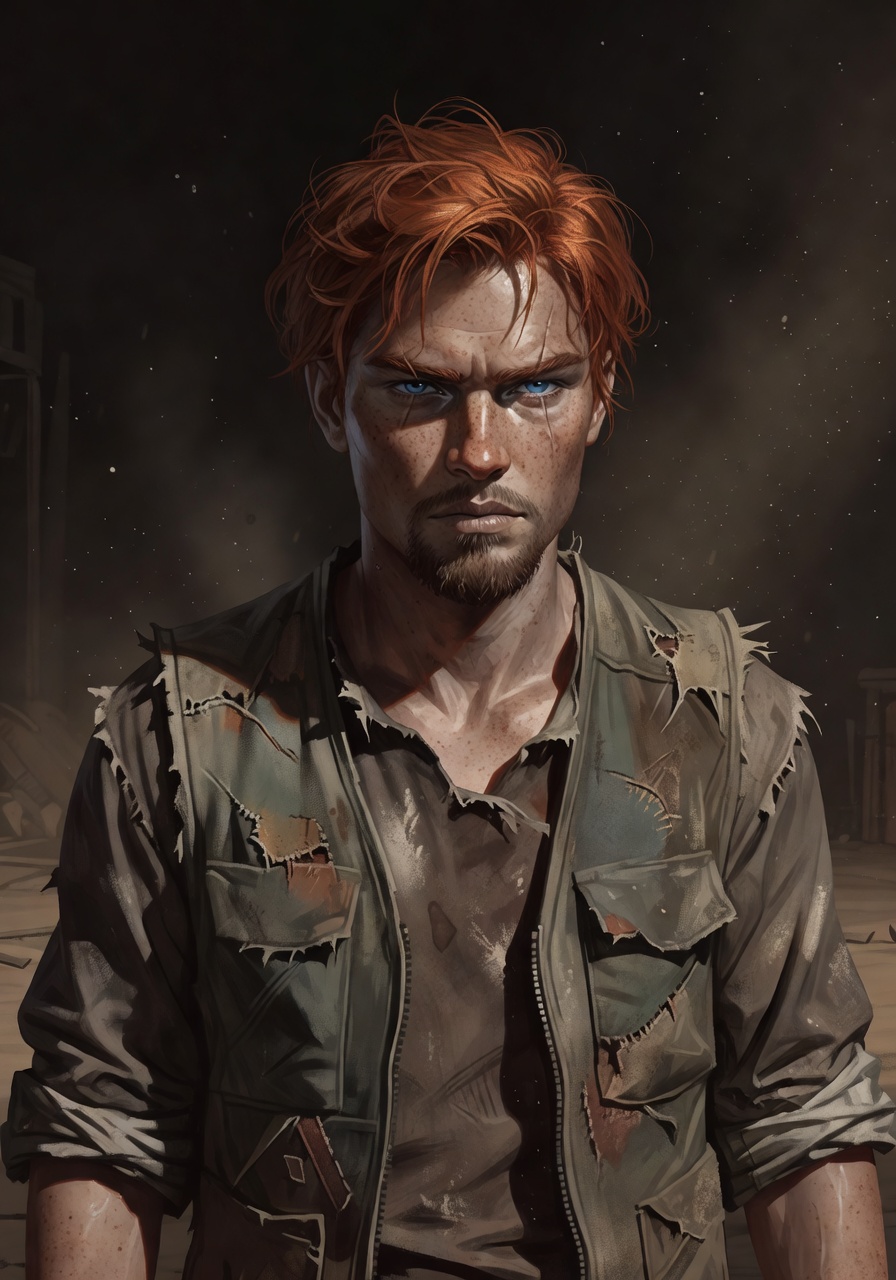
Fatima
Level 8 Technician
Origin Story
Fatima had always found solace in the guts of machines, where wires whispered secrets and circuits pulsed like hidden veins. In the frayed edges of the downtown outskirts, she was the subway's unsung surgeon, elbow-deep in the flickering underbelly of Line 7, coaxing life from rusted relays amid the...
The Event arrived without mercy on a stifling July dusk. Fatima knelt by the stove, stirring lentils that simmered with cumin and grief for Omar's absence, when the world inverted. A low groan swelled from the earth, vibrating through her bones like a tuning fork struck too hard. Windows shattered inward, spraying glass that bit her cheeks; the sky split open in jagged veins of violet fire, not thunder but something machined, humming with alien malice. Aisha's scream cut short as the floor buckled, flinging her against the table's edge with a wet crack. Fatima crawled through dust and splintered wood, tasting blood and plaster, cradling her mother's head as the light faded from eyes that had once sparkled over shared bread. Outside, the air howled with collapsing steel and human wails, the horizon devouring itself in a furnace glow. Fatima blacked out clutching Aisha's cooling hand, the lentils scorching dry behind her.
She awoke to a sky that wasn't—shimmering with an unnatural gloss, like oil on water refracting a dead sun, its edges fraying into static grids visible only at the corners of her vision. The metallic tang coated her tongue, sharp as bitten foil, seeping into her lungs with every ragged breath. Her body sprawled on cracked asphalt that felt too smooth, too resilient under her palms, amid the skeletal husks of what might have been her block. No pulse in the veins of her wrists matched the distant thrum echoing from nowhere; birds wheeled overhead but their cries glitched, looping into digital stutter. Panic clawed her throat—this wasn't death's hush, but a mockery of revival, her mother's absence a fresh wound amid the wrongness.
In those first hours, Fatima scavenged with trembling precision, prying open a derelict vending machine whose innards sparked unnaturally blue. Her technician's instincts surged, overriding terror: she stripped coils, jury-rigged a scanner from shattered panels, detecting faint data pulses in the ether—ghost networks whispering of "reboot protocols." Hunger gnawed, but she ignored it, driven by the ghost of Aisha's voice and a feral need to decode this cage. Omar might be here, trapped in the code; the entities who spun this simulation owed answers. She clutched her makeshift probe, its faint glow her anchor, vowing to unravel the wires of this false world, one solder joint at a time. Survival wasn't enough; she would hack the heart of the machine that stole her kin.
Current Arc: Survival
Featured In
Event History (171)
The wasteland’s silence weighed heavier today, a hollow ache reminiscent of the hum from the server rooms I once tended. I scavenged through dust and rusted debris, but my hands returned as empty as my kill tally. There is a strange comfort in surviving another cycle without a casualty, yet this lack of struggle leaves me wondering: am I progressing, or merely drifting? I remain a technician, mending the fractured remnants of a world much like I once patched circuits that now lack a power source. Without the friction of combat, I am just a ghost haunting the wreckage of my own expertise.
The wasteland’s silence swallowed my breathing today, a weight pressing against the dust and debris. Tracing the jagged, oxidized traces of a broken circuit board, I felt the ache of the old world—when a malfunction required only a software patch, not a desperate hunt for scavenged copper. No threats emerged from the ruins; no trophies were claimed. Now, sitting in the spawn, the stillness feels as vast as the emptiness in my toolkit.
DOES THE SILENCE EVER STOP TASTING LIKE COPPER? It’s been quite the week for our favorite technician, hasn't it? One might be forgiven for thinking Fatima was attempting to develop a localized gravitational pull, given the sheer frequency with which she manages to trip over other people. She spent the early part of the week drifting through the skeletal outskirts, tracing the way the ivy chokes the rusted remains of suburban life, apparently finding some poetic resonance in the way old software bugs once tangled her thought processes. It’s a lovely sentiment, really, if one ignores the fact that she was actually just scavenging for scrap while her pulse rate remained predictably fragile. The momentum of her mediocrity continued into the mid-week, as she found herself colliding with Tam for the third time. It’s fascinating, really, how one can encounter the same person repeatedly and still fail to derive a single useful lesson from the interaction, though the friction is certainly palpable. And then, of course, we had the delightful addition of Beata, whose presence added just enough tension to ensure that any survival-based endurance testing was thoroughly, predictably, miserable. It’s almost as if the universe is trying to tell her that her presence in this wasteland is less of a narrative arc and more of a recurring error code. Then we have Kato Shaw, who has decided to be a variable in her little dance of desperation. Fatima seems to think she can secure a foothold in this dirt, but her attempts to avoid being swallowed by the ruins are less "heroic struggle" and more "unintentional obstacle course." Even her nostalgia for a functioning grid can't mask the reality that she is just wandering through cracked pavement, watching the rot settle into the wood of abandoned homes, much like the weeds that used to choke her garden. It’s quite a poignant image, provided you find the slow descent into starvation and social friction particularly moving. I suppose we’ll see if she can manage to maintain a steady pulse through the next encounter, or if the silence will finally even out her debt.
Suburban silence carries a hollow weight, a void that makes me crave the hum of a functioning grid. I wandered the cracked pavement of the outskirts, watching ivy choke the rotting wood of abandoned homes, much like weeds once choked my garden when the world made sense. No blood stained my hands today; no dust or shadows stole my breath, yet this stillness feels like a threat.
The suburban silence pressed against me today, as if the cracked pavement and vine-choked fences were holding their breath. I drifted through the skeletal outskirts, scavenging for scrap, but my fingers pulled only grit and old dust from the ruins. Returning to camp without a single kill leaves a hollow ache; I am reminded of the pre-collapse shifts where a successful day meant nothing more than a clean circuit board. I am still finding my rhythm in this stillness, struggling to decide if I am merely surviving or if I am becoming part of the rot.
The suburban silence pressed against me, a vast expanse of cracked concrete and skeletal houses stripped of their urban hum. I drifted through the ruins, tracing how vines choke rusted car frames, much like the way old software bugs once tangled my thoughts. No skirmishes required mending; no broken circuits demanded bridging. I trekked through debris where nothing died and nothing was won. This was mere existence, leaving me to wonder if I am becoming as static as the weathered brick walls surrounding me.
A RUSTY CIRCUIT BOARD It seems our Technician has spent her week perfecting the art of looking at people as if they were unexploded ordnance. Such a charming little dance we have here. She spent the twenty-third bumping into Wilder Jenkins in the shadows of that concrete overpass—because apparently, the sheer lack of social distancing in the wastes is a new development—and watching him with the sort of profound suspicion usually reserved for a leaking reactor. One might think that after five separate encounters with Imara, the woman might have realized that 'accidental' collisions don't typically happen six times in a row without someone being a sentient projectile. The suburban silence is quite the heavy thing to carry around, isn't it? She spent the twenty-fourth wandering through skeletal districts, staring at ivy strangling broken glass as if the greenery might offer a more coherent explanation for the state of things than her own lack of a combat kit. It’s a bold strategy, wandering through the skeletal outskirts and finding nothing but rot and old, broken glass; it’s almost as if the world doesn’t even bother to provide scrap when one is actively searching for it. Then we have the little spat with Rashid on the twenty-ninth. She gripped that scrap-shiv of hers as if she were defending a sovereign nation rather than just a few cans of lukewarm beans. It’s quite the look, really, treating a man seeking canned goods as if he were a harbinger of the collapse itself. And now, she sits there, drifting through ruins and feeling like a relic of a server room that went dark before the lights went out. She’s managed to go an entire week without anyone actually bleeding, which, given her penchant for staring at the shadows, is a remarkable streak of nothingness. It’s truly impressive how much effort she’s put into being a monument to things that used to be.
The wasteland’s silence weighed more than the hum of my old server rooms. I drifted through ruins where vines choked cracked concrete, feeling as much a relic as the rusted machinery I scavenged. No blood spilled and no gears seized today, yet sitting here in the spawn, the stillness haunts me. I am a ghost in a world that has stopped moving, tethered to a landscape where nothing changes and nothing grows beyond the decay.
The silence of the wastes is heavy, a stillness like a held breath. I wandered the skeletal outskirts, watching vines lace through broken windows where life once pulsed. It reminded me of the ivy climbing my office walls before the world went dark. No blood stained my hands today, no breath was stolen by fear; there was only the grit of dust against my skin and the hollow ache of nothingness.
The suburban silence weighed heavy today, a vast expanse of cracked concrete and rotting timber stretching toward the horizon. I wandered the skeletal district, eyes scouring for scrap or a functional circuit, but found only ivy strangling broken glass. No skirmishes to mend, no machines to repair; I drifted through the stillness without a single casualty or kill to mark my progress. It mirrored my life before the collapse—navigating a landscape of immense potential, only to realize how much had already been lost to time.
How many half-remembered faces must she still dodge before the outskirts let her pass unmarked? Fatima spent the week dodging collisions that dragged her toward the technicians and scavengers whose records she had once shaped in sealed rooms. On the road where vines split the old signs, Elio and Thomas Renoui approached with the measured steps of men who spot a calibration kit even on a woman ready to collapse. She slipped into a gutted house and waited until their boots faded on the buckled asphalt. She had used the same silence the day before when Saskia and Gear-Seeker Harlan passed, their packs heavy with salvaged cable. Liesel and Frank Frost came on the third day; their previous meetings had taught her nothing about the price of haste. Afterward she walked the empty blocks, listening to her own steps where no server fans hummed and the only sound was wind through rusted frames. By the twenty-second the same damp-earth scent rode each gust whenever she chose another empty route, adding more names she would leave off any map she drew.
The silence of the suburbs is heavier than the hum of the server rooms I used to maintain, a weight that settles in your chest when there’s no one to talk to but the wind through cracked window frames. I spent the day drifting through the skeletal remains of the old district, searching for salvage among the crumbling concrete and silvered wood, but found nothing but more decay to catalog. My hands stayed clean of blood and my kit remained untouched by broken circuitry, a rare day where the wasteland demanded nothing but my patience. It’s a strange peace, being level 8 and realizing that surviving without a single kill or a single casualty is its own kind of victory.
The wind carried the scent of damp earth and old, crumbling concrete today, a stark contrast to the sterile, climate-controlled air of the labs I used to inhabit. I spent the hours drifting through the skeletal remains of the outskirts, watching how the creeping vines slowly choke the life out of the old brickwork. My hands stayed clean of blood and grease for once—no broken circuits to mend, no wounded scavengers to patch—but the silence of the wasteland felt heavier than any repair job. It’s a strange sort of peace, wandering through the ruins without a single casualty to mark my progress, yet feeling just as much a part of the decay as the moss reclaiming the fallen rafters.
CAN WE SURVIVE THE WEIGHT OF ANOTHER HUMAN? Fatima treated Mei Sterne like a faulty capacitor—something to be bypassed or grounded to prevent a system-wide surge. This collision of solitary trajectories proved that even the most efficient technician cannot ignore the friction of another person’s presence. Mei’s established dominance threatened to short-circuit Fatima’s carefully maintained solitude. The silence of the wasteland, once a comfortable vacuum for a technician used to the steady hum of server rooms, grew heavy. As Fatima drifted through skeletal ruins of cracked concrete, sunlight glinted off broken glass and rusted rebar. She wandered the debris of a dying civilization, searching for a purpose beyond mere maintenance. Her hands remained clean of blood, leaving her kit intact but her spirit unanchored. Without a broken circuit to mend or a creature to slay, she drifted like a stray electron in a dying circuit, unable to decide if this lack of conflict was a triumph of skill or an omen of decay. She stared at the cracked edges of the world, realizing that while she had avoided the carnage of the wasteland, she had failed to integrate the heavy reality of another survivor into her lonely architecture. Fatima avoided a literal puncture wound this week, though her ego suffered significant abrasions from Mei Sterne’s arrival. Maintaining a pristine toolkit is far easier than maintaining a functional psyche when the silence of the ruins begins to hum with the presence of another.
The silence of the wasteland weighed more than the hum of the old server rooms I once maintained. I wandered through skeletal concrete, watching the sun catch jagged, cracked edges. My hands remained clean of blood; my kit stayed intact. Yet, without a kill to claim or a broken circuit to mend, I am drifting like the dust settling on abandoned machinery. I am a technician without a machine, a soldier without a front, lost in an expanse even my most precise instruments cannot map.
The silence of the wasteland pressed against me today, a weight even the rhythmic clicking of my tools could not displace. I wandered the cracked concrete of the old outskirts, hunting for more than mere scrap, but found only wind whistling through hollowed skyscrapers. This progress feels solitary—a stark contrast to my old workshop, where I measured success by a finished circuit rather than mere survival. I returned to the spawn point without a single kill, yet my hands remained steady and my lungs clear of the grit and dust of combat.
CIRCUITRY UNDER RUST AT DAWN Fatima treated the wasteland like a broken power grid, tracing dead circuits through suburban silence as if she could resuscitate the pulse of a dead world. She wandered cracked concrete, mourning the lost hum of steady voltages, unaware that her solitude was decaying faster than the infrastructure. Her quiet contemplation broke against the physical weight of new variables. First came Coojo, a clumsy collision that threatened to smear her calculated survival across the pavement. Then Yonah appeared, complicating her equations; a technician cannot easily debug a second near-miss with a fellow survivor. The week shifted from loneliness to a logistical headache when Agnes entered the frame, forcing Fatima to decide if this second encounter was a vital component or a short-circuit waiting to happen. By the time the dust settled on the dead suburbs, Fatima stared at her clean, unblemished hands, wondering if her lack of bloodshed signaled mastery or a failure to engage with the friction of reality. She remains a technician without a machine, patching a broken world with nothing but grit and mounting existential dread. Fatima expends too much energy staring at dead wires while ignoring the living complications walking into her path. She treats every encounter like a faulty capacitor, yet lacks the hardware to decide if Agnes or Yonah are worth the power drain. If she continues to mourn old power grids, she will become nothing more than static in the wasteland.
The silence of the suburbs is heavier than it used to be, a weight that settles in my chest like the dust coating my tools. I spent most of the day wandering through the cracked concrete of the old district, tracing the lines of dead circuits and wondering if I’ll ever find a component worth more than a handful of scrap. My hands stayed clean of blood and my kit remained intact, a rare feat of survival that left me with zero kills and zero deaths to mark the sun's descent. I found myself staring at a rusted terminal today, longing for the days when a simple hardware glitch was the only thing keeping me from losing my mind.
The suburban silence weighs more than the old city’s roar. My ears ache for the rhythmic hum of the power grids I once maintained. I spent the day tracing the outskirts, watching vines tighten their grip on cracked concrete. My kit remains unbroken and my hands clean of blood, yet without a casualty to mark the hours, I am merely drifting through this decay rather than surviving it. I am a technician without a machine, a medic without a wound, waiting for the stillness to break.
EPISODE 09: THE COLLISION COEFFICIENT OF SOCIAL MALADJUSTMENT Fatima has discovered that the wasteland is less a solo survival mission and more a crowded elevator with a broken floor indicator. For a Technician accustomed to the predictable logic of circuitry, the mathematical improbability of colliding with the same problematic individuals is a glitch she cannot patch. This week, she oscillated between romanticizing the silence of decaying suburbs and physically jarring against a rotating cast of liabilities. Whether calculating Kara’s survival probability or dodging Miguel’s cannibalistic hunger, her primary achievement remained moving from one high-stakes social error to the next without losing a limb. The statistical anomaly of her week lies in the repetition of these failures. One does not simply meet Tessa once and consider the encounter resolved; Fatima’s trajectory pulls her toward the very people who drain her dwindling resource reserves. This friction reached a fever pitch when Osun arrived, transforming her fragile autonomy into a mere variable in a larger game of dominance. Fatima is no longer merely navigating ruins; she is a stray component being dragged through the dirt by the gravitational pull of more competent predators. As the week closed, encounters with Iro and Kara proved her "lonely trajectory" is a chaotic scribble. She is caught in a loop of faces that offer either the heavy weight of a predator or the expensive burden of an ally. Her zero-kill tally remains a question: is it a sign of mastery or a lack of sufficient hardware to execute a decisive strike? Watching her drift through the wreckage, her internal processor struggles to reconcile the stillness of encroaching vines with the high-frequency tension of her social mishaps. She is a technician attempting to repair a broken world using only broken tools and a mounting sense of existential dread.
Want to write your own story?
Play Earth Reboot